
6 Reasons Why Body Micro-Infusion Does What Creams, Collagen and Rollers Can't

For women who already did the hard part. The weight came off. The skin didn't follow.
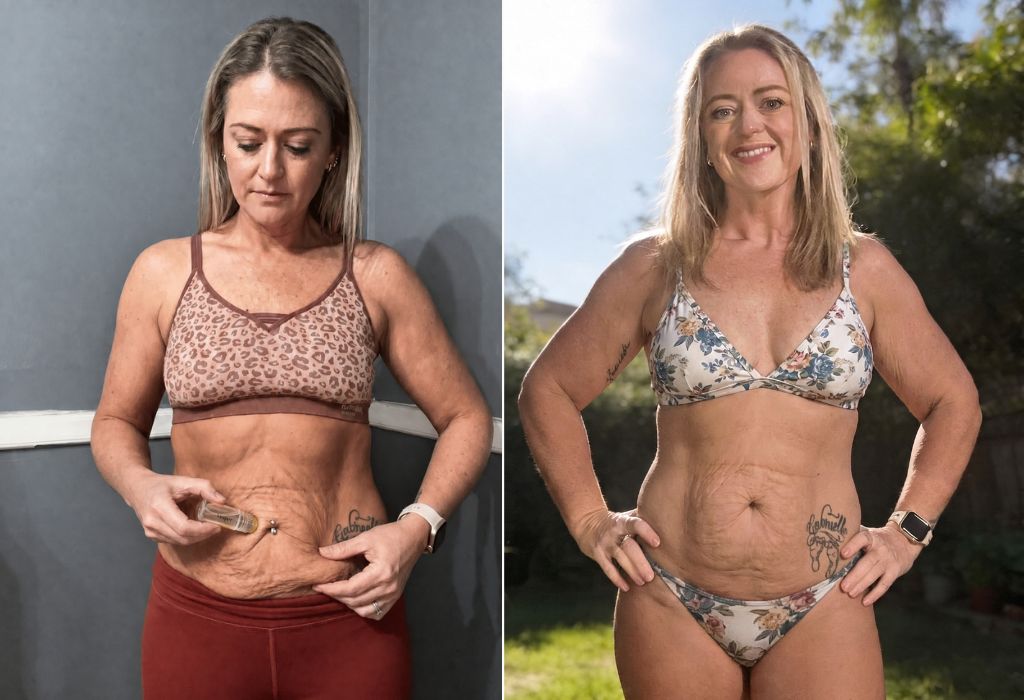
When skin stays loose after weight loss, the explanations are usually the same: age, genetics, or skin that was stretched too far.
They sound reasonable because they describe what is visible. They do not explain why the skin adapted as the body became larger, then seemed to stop adapting when the body became smaller.
Skin responds to physical signals.
As the body grew, constant tension pushed the tissue to remodel and make room for the larger frame underneath it. When the weight came off, that tension disappeared and the support beneath the skin shrank away.
But no new event told the loose skin to reorganize around the smaller body. Nothing had injured it, so no focused repair response began.
That is why the usual solutions often change so little.
Creams moisturize the surface. Collagen is distributed throughout the entire body. Training builds the muscle underneath the skin.
None creates a repair event inside the loose area itself.
Body micro-infusion does. For 6 reasons:
It needles and infuses in the same press
Each press opens thousands of tiny channels across the area you treated.
The body reads them as damage. Blood moves in. Collagen-building cells start working across that exact patch of skin.
The same press delivers the infusion.
Collagen peptides and hyaluronic acid go through those channels while they are still open, so the skin is not left to repair empty-handed.
One system covers every area you've been hiding
Loose skin is rarely one place. It turns up on the stomach and the upper arms, or the thighs and the chest, and most women end up working around several zones at once.
That is what makes a small device feel pointless. If four areas changed, what good is something you press on one of them?
One Vesper system covers all of them.
Belly, arms, thighs, chest and décolletage, under the bust, neck, glutes, knees. A full pass takes about fifteen minutes, once a week.
Areas move at different speeds, so you start with whichever one bothers you most and add the others as you go.
Safe and painless to do yourself, weekly

Clinic devices run longer needles, with numbing cream and a clinician holding them. Vesper is deliberately lighter than that.
The head is fixed at 0.5mm, the range you can use at home, on yourself, every week. Each head arrives sterile and is used once.
No depth to adjust. No reusable roller to clean. No pressure setting to guess.
Most women describe a firm prickle rather than pain. The area stays lightly pink for a few hours afterwards, which is the repair starting.
After 30 your body makes less collagen every year. Weight loss asks for it at the worst possible moment.
Collagen production drops roughly 1% a year after 30.
Then rapid weight loss removes the volume underneath in a matter of months, asking the skin to reorganize around a smaller body at the exact moment it has the least material to do it with.
That is why skin that once bounced back now stays loose, and why waiting it out so rarely changes anything.
Two shortages, then. No reason for the area to rebuild, and less material to rebuild with than there once was.
A weekly session answers both. The stamping restarts the repair. The infusion supplies the collagen peptides while that repair is active.
Surgery is the wrong answer for 94% of women with loose skin

Removal and remodeling are two different jobs.
Most women pricing a tummy tuck or an arm lift are not only bothered by how much skin is left. They are bothered by the condition of it: how thin it looks, how it folds, how crepey the surface has become, how loosely it moves.
Excision reduces the amount of skin. It does not repair the texture, the stretch marks or the weakened structure of the skin that stays.
The quotes run $15,000 to $42,000. General anaesthetic, surgical drains, a scar that stays for life, weeks arranged around recovery.
Body micro-infusion works in the opposite direction. It does not cut skin away. It works on the skin already covering your body, so what you keep becomes firmer, denser and better supported across twelve weekly sessions.
Fifteen minutes at home. No anaesthetic. No scar. No weeks of your life spent recovering.
Over 38,000 women have already run it on their own skin
Some started while the weight was still coming off.
Others started months after reaching their goal, when the skin was already loose and surgery had begun to look like the only honest option left.
Two of them, in their own words.
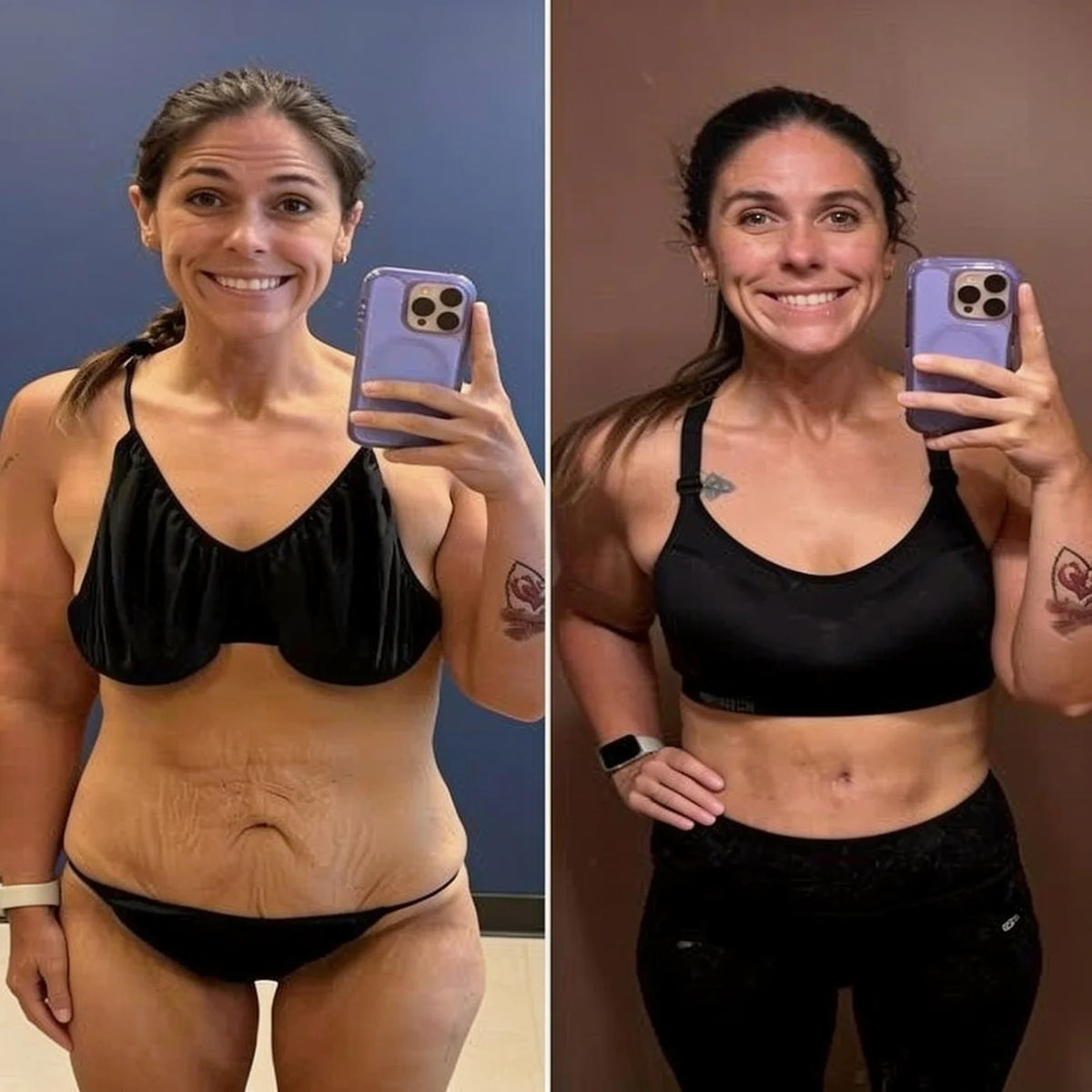
"I canceled my surgery consult." I can't believe something I bought on impulse at 1am ended up saving me from a $17,500 surgery. I had a tummy tuck consultation scheduled. My belly isn't perfect, I still have loose skin, but the improvement is enough that I canceled the consult. My skin is visibly tighter. I went from 'surgery is my only option' to 'let me see how far this goes.'
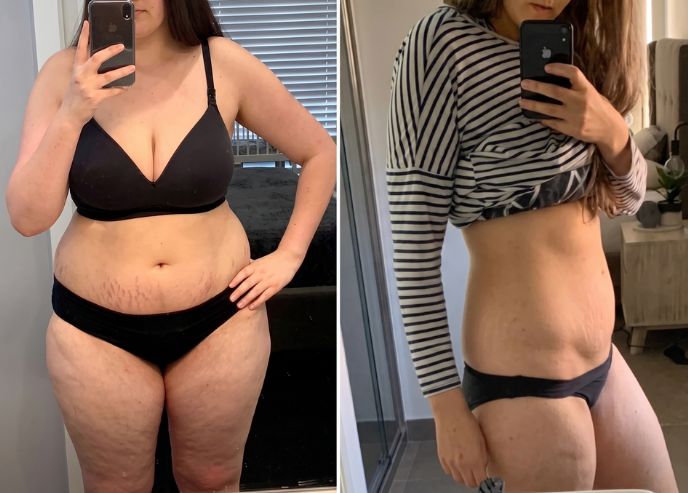
"I really think this helped my skin keep up with my body changing." After losing over 60 pounds my skin was a mess — bright red stretch marks all over my waist and crepey skin everywhere. I've been using this protocol for a little over 3 months, pretty much every week. My stretch marks have faded so much they are barely visible now, and my skin looks smoother and feels stronger and firmer than it ever has. For the first time in forever, I actually feel good putting on a swimsuit.
And if your skin does not do what theirs did, you are not out of pocket for finding out.
Complete the twelve weeks, take the progress photos, and if the treated skin isn't holding itself up better than the day you started, send them to us and we'll refund every dollar.
What to expect over twelve weeks
The first change is usually easier to feel than to see. The skin on the arms feels firmer between the fingers. Crepey texture stops catching the light so sharply. The thighs start to look smoother. Across the stomach, the skin looks less empty, moves less when you walk, and feels better supported underneath.
Vesper does not remove skin. It changes the condition of the skin that remains. So the question at twelve weeks isn't whether every fold is gone. It's whether the area looks, feels and holds itself better than it did the day you started.